
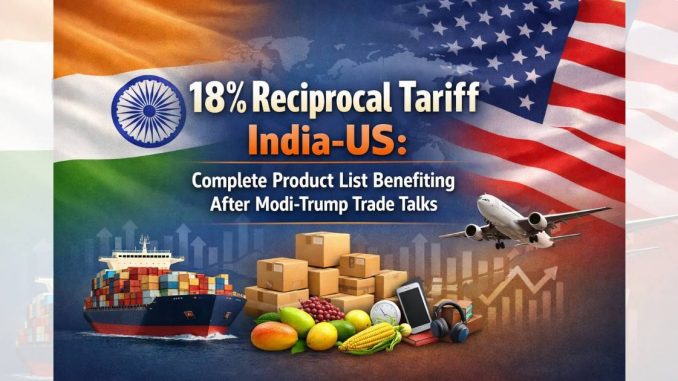
The 18% reciprocal tariff India-US deal has emerged as one of the most searched trade developments following the recent Modi-Trump summit, as exporters and businesses rush to understand which products stand to gain. Under the new interim trade framework, the United States has agreed to slash import duties on several Indian goods from nearly 50% to 18%, significantly boosting the competitiveness of Indian exports in the American market. From Surat’s diamond industry to Tiruppur’s textile hubs, a wide range of sectors are expected to benefit from this tariff reduction, marking a major shift in bilateral trade relations between the two countries.
What Is the 18% Reciprocal Tariff India-US Deal?
The 18% reciprocal tariff India-US deal refers to a key outcome of the recent Modi-Trump trade talks, under which the United States agreed to significantly reduce import duties on select Indian goods. The tariff rate has been brought down to 18% from earlier levels that went as high as 50%, offering immediate relief to Indian exporters targeting the US market.
A reciprocal tariff means both countries aim to maintain balanced trade conditions by adjusting duties in a mutually agreed framework. In this case, the tariff reduction is part of an interim India-US trade arrangement, designed to ease trade barriers while negotiations continue toward a broader bilateral trade agreement.
The deal is expected to boost India’s export competitiveness, especially in labour-intensive and manufacturing sectors. By lowering costs for American importers, the 18% reciprocal tariff India-US framework creates fresh opportunities for Indian industries that were previously constrained by high duties.
Products Benefiting from the 18% Reciprocal Tariff
Several Indian export sectors are set to benefit from the 18% reciprocal tariff India-US deal, particularly those that were previously affected by steep US import duties. Key beneficiaries include gems and jewellery, with Surat’s diamond industry gaining improved price competitiveness, along with textiles and apparel from major hubs such as Tiruppur, Surat, and Ludhiana, where exports are heavily dependent on the US market.
In addition, leather goods, footwear, chemicals, plastics, rubber products, and light engineering items fall under the product categories enjoying reduced duties. The tariff cut is expected to strengthen India’s position in global supply chains, while helping exporters expand volumes and secure new orders under the 18% reciprocal tariff India-US framework.
Why This Topic Is Trending on Google Right Now?
Search interest around the 18% reciprocal tariff India-US deal surged immediately after reports emerged from the Modi-Trump summit, where both sides outlined the interim trade framework. Exporters, investors, and industry bodies began searching for product lists, tariff rates, and eligibility details, driving a sharp spike in Google trends related to the tariff cut.
The topic is also trending due to its direct economic impact on key Indian industries, including textiles, gems and jewellery, and manufacturing MSMEs. With duties dropping from nearly 50% to 18%, businesses are reassessing pricing, export volumes, and future contracts, making the 18% reciprocal tariff India-US framework one of the most searched trade-related topics at present.
Economic Impact and What Comes Next
The 18% reciprocal tariff India-US deal is expected to provide a measurable boost to India’s export-led sectors, particularly MSMEs and labour-intensive industries. Lower tariffs improve price competitiveness in the US market, potentially increasing export volumes, supporting employment in manufacturing hubs, and strengthening India’s overall trade balance with the United States.
Looking ahead, the tariff cut is being viewed as a stepping stone toward a broader India-US trade agreement. Policymakers and industry leaders are closely watching whether select sectors could move toward zero or further reduced tariffs in future negotiations, making the 18% reciprocal tariff India-US framework a key indicator of how bilateral trade relations may evolve.
Also read: Building for the World: The Operational Framework for Indian Startups Expanding into GCC Markets
Add Business Saga as a preferred source on Google – Click Here
Last Updated on: Saturday, February 7, 2026 2:49 pm by BUSINESS SAGA TEAM | Published by: BUSINESS SAGA TEAM on Saturday, February 7, 2026 2:49 pm | News Categories: Business News Today
About The Author


Leave a Reply