
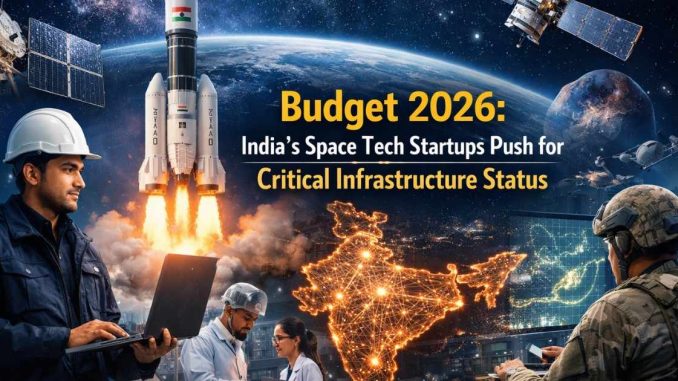
As India heads into Budget 2026, the spotlight is steadily shifting towards an unlikely but rapidly rising sector: space technology. Once seen as the exclusive domain of a state-led scientific establishment, space has now become a vibrant arena of private entrepreneurship, deep technology innovation, and global commercial ambition. At the heart of the sector’s pre-Budget expectations is a clear and consistent demand from founders, investors, and industry associations recognition of space infrastructure as critical infrastructure under India’s policy and financing framework.
Over the past few years, India’s space ecosystem has undergone a structural transformation. A growing number of private startups are building satellites, launch vehicles, earth observation platforms, and space-based data services. These companies are not only complementing national missions but are also targeting global markets, positioning India as a competitive alternative in the international space economy. However, despite the momentum, the financial and regulatory ecosystem has not evolved at the same pace as the technological ambition of these firms.
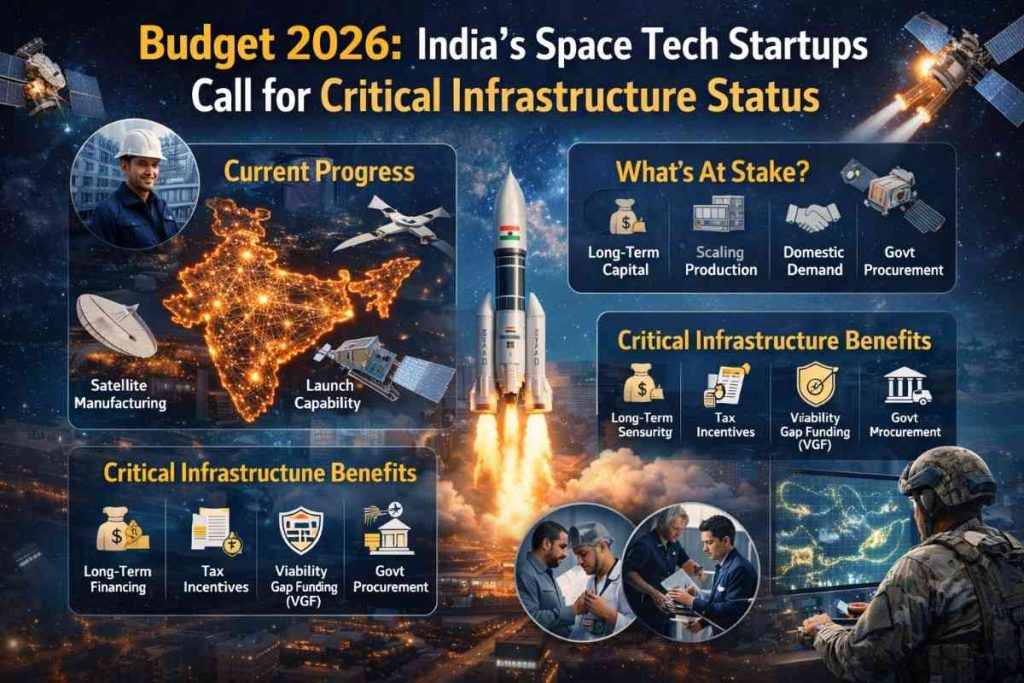
Space technology is inherently capital-intensive and long-gestation. Developing launch systems, manufacturing satellites, and deploying constellations demand high upfront investment, specialised infrastructure, and years of testing before revenues stabilise. For startups operating in this environment, access to patient, long-term capital becomes as critical as engineering talent. Traditional venture funding, while essential in the early stages, is often insufficient for scaling hardware-heavy operations. This is where the demand for critical infrastructure status becomes strategically significant.
In India’s economic framework, sectors classified as critical infrastructure enjoy preferential access to long-term financing, lower cost of capital, and tailored lending mechanisms. Roads, power, ports, telecom, and renewable energy have long benefited from this classification, allowing projects with extended payback periods to attract institutional funding. Space startups argue that satellites, launch facilities, and ground systems are no different in nature or importance. These assets underpin communication networks, navigation systems, disaster management, weather forecasting, national security, and a growing digital economy that increasingly relies on space-based data.
For space entrepreneurs, critical infrastructure status is not merely a symbolic recognition but a practical enabler. It would allow companies to tap into infrastructure-focused lenders, issue long-tenure bonds, and access financing instruments designed for projects that mature over decades rather than quarters. Lower borrowing costs could significantly alter the economics of space missions, making Indian firms more competitive against global peers who already operate within supportive policy environments.
Beyond financing, the demand also reflects a broader push for policy alignment with strategic realities. Space assets today are deeply embedded in civilian governance and defence preparedness. From monitoring climate change and agricultural productivity to enabling secure communications and surveillance, space systems form the invisible backbone of modern states. Industry leaders argue that treating space infrastructure on par with telecom towers or power grids is not only logical but necessary in an era where data and connectivity define national capability.
Budget 2026 is also being seen as an opportunity to strengthen domestic procurement frameworks. Indian space startups have repeatedly highlighted the need for predictable demand from government and public-sector users. A clear procurement policy favouring domestic space solutions could provide stable revenue pipelines, allowing companies to plan capacity expansion, invest in manufacturing, and build global credibility. Such measures would reduce dependence on imported systems while accelerating the indigenisation of critical technologies.
The global context adds further urgency to the sector’s appeal. Internationally, space has become a highly competitive and strategic industry, with governments actively backing private players through long-term contracts, research funding, and infrastructure support. Countries that have successfully built commercial space ecosystems have done so by aligning public spending with private innovation. Indian startups see Budget 2026 as a chance for the country to adopt a similar approach, leveraging private enterprise to expand national capabilities without placing the entire burden on public institutions.
There is also a strong economic argument behind the demand. Space technology has a powerful multiplier effect, driving innovation across artificial intelligence, advanced manufacturing, materials science, geospatial analytics, and climate technology. As downstream applications of satellite data expand across agriculture, logistics, insurance, urban planning, and fintech, the value created by space infrastructure extends far beyond the sector itself. Recognising space as critical infrastructure could accelerate this spillover, embedding space-enabled services into the core of India’s digital and industrial growth story.
As policymakers finalise the contours of Budget 2026, the space sector’s expectations reflect both confidence and caution. Confidence in India’s technical talent and entrepreneurial capacity to compete globally, and caution that without structural financial and policy support, momentum could slow at a critical juncture. For space tech startups, critical infrastructure status represents a bridge between ambition and execution, between experimental success and industrial scale.
Whether the Budget delivers on this front will signal how India views its space economy in the years ahead as a niche innovation sector or as a foundational pillar of national infrastructure. For an industry aiming to place India firmly among the leading space-faring commercial powers, the answer could define its trajectory for decades to come.
Also Read : https://startupmagazine.in/practical-guide-for-founders-to-balance-growth-profitability-and-team-efficiency/
Add businesssaga.in as preferred source on google – Click Here
Last Updated on: Tuesday, January 27, 2026 9:48 am by BUSINESS SAGA TEAM | Published by: BUSINESS SAGA TEAM on Tuesday, January 27, 2026 9:48 am | News Categories: Startup News, Trending News
About The Author


Leave a Reply