

In the past, the geography of Indian startup fundraising was brutally simple. Capital flowed toward pin codes clustered around Bengaluru’s Outer Ring Road, Mumbai’s Bandra-Kurla Complex, and Gurugram’s Cyber City. Outside these corridors, ambition often stalled—not because ideas were weak, but because access to capital was. In 2026, that map is being redrawn. From Coimbatore to Indore, Kochi to Jaipur, Tier-2 cities are no longer peripheral to India’s startup story. They are becoming central characters, crafting a new blueprint for fundraising that begins in local districts and increasingly ends with global term sheets.
This shift is not accidental. It is the outcome of several converging forces—digital-first investing, sector-specific innovation, government-backed ecosystems, and a new generation of founders who see location as leverage rather than limitation. Together, they are dismantling the long-held belief that serious capital only backs metro-born startups.
At the heart of this transformation is the changing behavior of investors themselves. Post-pandemic investing normalized remote diligence, virtual demo days, and asynchronous founder interactions. Global venture funds that once insisted on in-person meetings now evaluate startups across time zones with little friction. For Tier-2 founders, this has been a quiet revolution. The absence of frequent physical access to Sand Hill Road or South Mumbai is no longer disqualifying. What matters more is clarity of problem, depth of execution, and scalability of the solution.
Yet the new fundraising blueprint does not begin with foreign capital. It starts locally, often at a district or regional level. Angel networks rooted in Tier-2 cities—comprising first-generation entrepreneurs, doctors, factory owners, and returning professionals—have become the first believers. These investors may write smaller cheques, but they bring something equally valuable: contextual understanding. They know the local supply chains, regulatory bottlenecks, and customer behavior intimately. For startups in agritech, manufacturing SaaS, logistics, healthtech, and vernacular commerce, this local capital provides early validation that metro-based investors sometimes miss.
From there, founders are increasingly leveraging state-backed incubators and university-linked innovation centers as credibility bridges. Incubation today is not just about desk space; it is about structured governance, audited reporting, and mentor-led readiness for institutional capital. Venture funds scanning Tier-2 ecosystems now actively look for startups that have passed through recognized incubators, viewing them as de-risked entry points. The imprimatur of a credible incubator often accelerates conversations that once took months.
What truly differentiates the new Tier-2 fundraising playbook is sectoral focus. Unlike earlier waves of startups that tried to replicate metro consumer internet models, today’s Tier-2 founders are building where their unfair advantage lies. Manufacturing automation startups are emerging close to industrial clusters. Climate-tech companies are piloting solutions near farms and water-stressed regions. Health-tech ventures are testing scalable care delivery in districts that reflect the realities of India’s mass market. These are not diluted versions of metro ideas; they are globally relevant solutions forged in complex, real-world conditions.
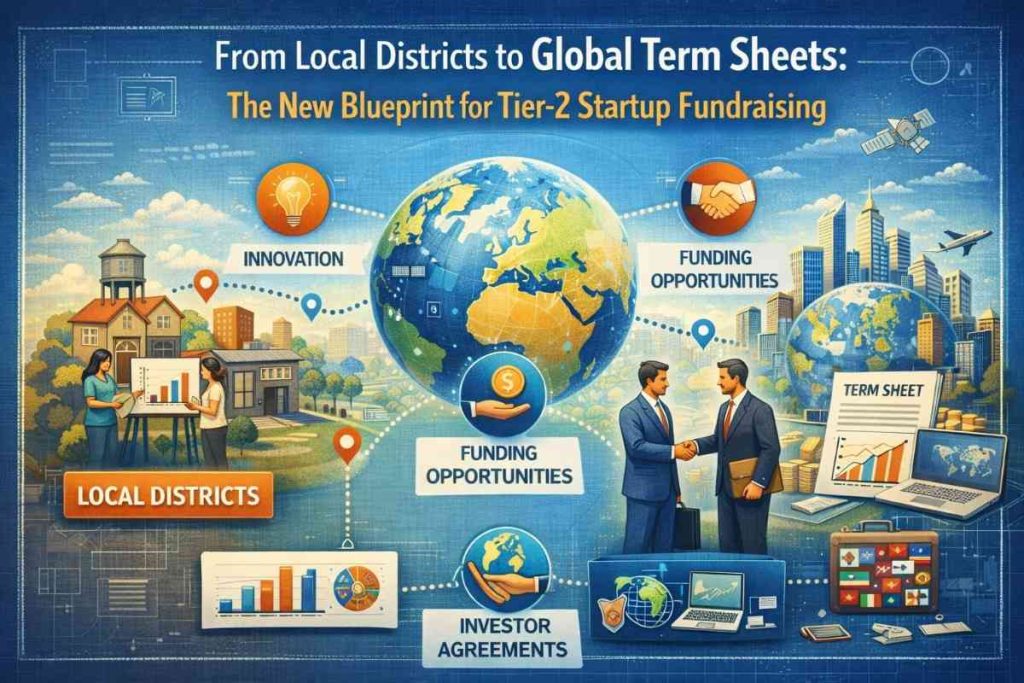
This grounded innovation is attracting global capital with surprising speed. International funds, especially those focused on emerging markets, are actively hunting for startups that can demonstrate scalability beyond elite urban consumers. Tier-2 startups, by default, operate in price-sensitive, infrastructure-constrained environments. If they can succeed there, the logic goes, they can succeed anywhere. Term sheets from Singapore, Dubai, Europe, and the US are now landing in founder inboxes from cities that rarely featured in pitch decks a decade ago.
Another critical evolution is in founder mindset. Earlier, Tier-2 founders often saw relocation as inevitable—a move to Bengaluru or Delhi was considered a rite of passage to unlock funding. Today, many are choosing to stay put, building distributed teams and maintaining headquarters in their home cities. This is not just emotional loyalty; it is strategic. Lower burn rates, higher employee retention, and proximity to core customers translate into stronger unit economics. Investors, once skeptical, are now recognizing this as a competitive advantage rather than a risk.
Digital visibility has also become a powerful equalizer. Founders from Tier-2 cities are increasingly intentional about thought leadership, data transparency, and storytelling. Well-crafted investor updates, consistent presence on professional platforms, and participation in global demo days are shrinking perception gaps. In an era where the first meeting often happens on a screen, narrative discipline matters as much as network proximity.
However, challenges remain. Access to later-stage capital, especially Series B and beyond, is still thinner outside metros. Many Tier-2 startups eventually open investor relations offices in major cities or abroad to sustain momentum. Legal, compliance, and financial advisory ecosystems are improving but remain uneven. Yet even these gaps are narrowing as professional services firms follow capital into emerging hubs.
What is unmistakable is that the old center-periphery model of Indian startup fundraising is breaking down. The new blueprint is layered and fluid: local angels for early belief, regional incubators for structure, national funds for scale, and global investors for acceleration. Geography is no longer destiny; execution is.
As India’s startup ecosystem matures, the rise of Tier-2 fundraising is not a footnote—it is a structural shift. The next wave of breakout companies may not emerge from glass towers in metros, but from quieter districts where problems are sharper, solutions are harder-won, and ambition is no less global. From local districts to global term sheets, Tier-2 India is no longer knocking on the door of venture capital. It has found a way in—and it is here to stay.
Add businesssaga.in as preferred source on google – Click Here
Last Updated on: Wednesday, January 28, 2026 5:31 pm by BUSINESS SAGA TEAM | Published by: BUSINESS SAGA TEAM on Wednesday, January 28, 2026 5:31 pm | News Categories: Startup News, Trending News
About The Author


Leave a Reply