
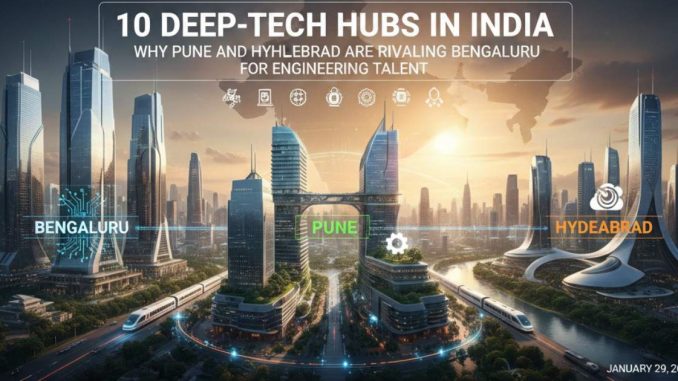
For more than two decades, Bengaluru has been the unquestioned nerve centre of India’s technology story. From early IT services to the rise of SaaS unicorns and cutting-edge work in artificial intelligence and biotechnology, the city built a reputation that few could rival. But India’s deep-tech landscape is no longer a one-city narrative. A new, more distributed map of innovation is taking shape, with Pune and Hyderabad emerging as serious contenders for engineering talent, investment, and global relevance. Alongside them, several other cities are quietly building strength in specialised deep-tech domains, signalling a shift towards a polycentric technology ecosystem.
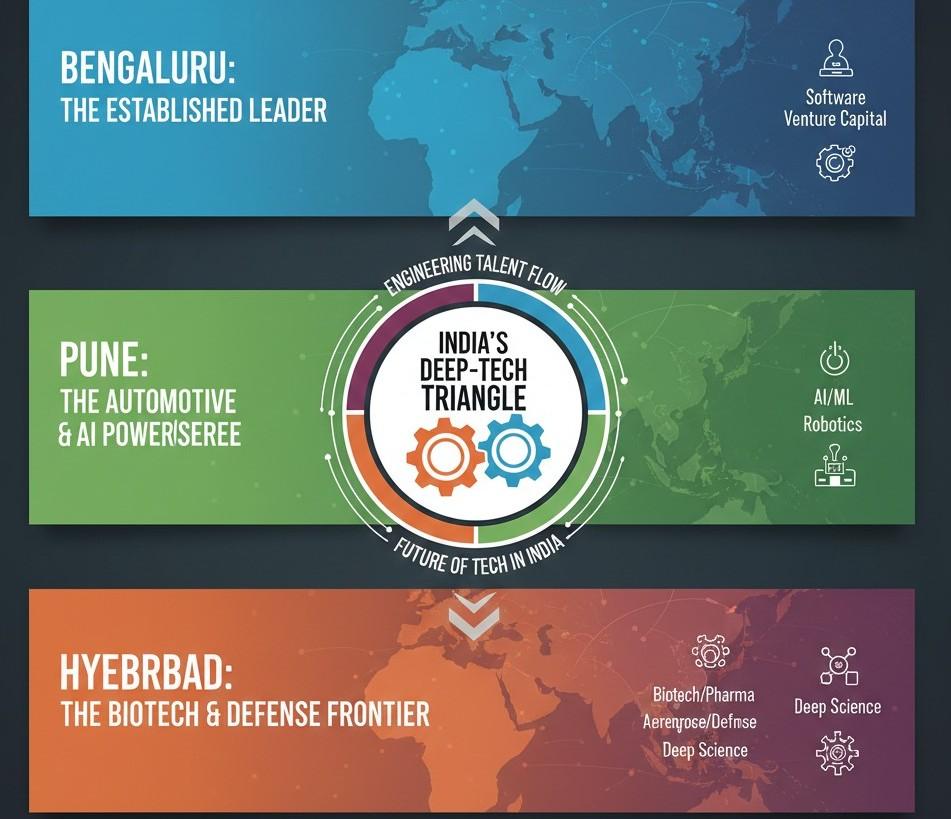
Bengaluru remains the country’s most mature deep-tech hub, hosting the largest concentration of startups, research labs, venture capital firms and multinational R&D centres. Its talent pool is vast and diverse, spanning AI, machine learning, space technology, climate tech, quantum computing and advanced biotechnology. The city’s success, however, has also created structural challenges. Rising costs of living, infrastructure stress and intense competition for talent have pushed companies to rethink their expansion strategies. Many are now looking beyond Bengaluru for sustainable, long-term growth.
Hyderabad has been one of the biggest beneficiaries of this shift. Once known primarily for IT services and back-office operations, the city has transformed into a hub for core engineering and deep-tech work. Global capability centres in Hyderabad today are no longer limited to support functions; they are building products, designing architectures and running advanced research in cloud computing, cybersecurity, data platforms and increasingly, semiconductors. A steady supply of engineering graduates, relatively lower costs and a government that has actively courted technology investment have helped Hyderabad position itself as a credible alternative to Bengaluru. For global firms, the city offers scale without the saturation.
Pune’s rise follows a different but equally compelling trajectory. Long associated with manufacturing, automotive engineering and higher education, Pune has quietly evolved into a strong product engineering and deep-tech hub. Its ecosystem blends software expertise with hardware design, embedded systems and industrial R&D, making it particularly attractive to companies working at the intersection of digital and physical technologies. The presence of top engineering institutes, a strong mid-career talent base and close proximity to Mumbai’s financial ecosystem have added to its appeal. For many firms, Pune offers the engineering depth of Bengaluru without the operational friction.
Beyond these three cities, India’s deep-tech story is being shaped by multiple regional hubs. Delhi-NCR has emerged as a centre for enterprise technology, cybersecurity and government-linked digital platforms, driven by proximity to policymakers and large enterprise customers. Mumbai, India’s financial capital, plays a critical role in fintech, data engineering and cloud infrastructure, where deep-tech innovation is closely tied to financial services and regulatory frameworks. Chennai continues to build strength in embedded systems, automotive electronics, robotics and semiconductor-adjacent manufacturing, supported by its industrial base and growing R&D investments.
Further east, Kolkata is attempting to reinvent itself through large technology parks and a renewed focus on AI, data centres and research-led innovation. While still at an early stage, its ambitions reflect a broader national push to decentralise technology growth. In western India, Ahmedabad is gaining visibility as a startup and research hub, particularly in health tech, fintech and applied AI, backed by academic institutions and a growing entrepreneurial culture.
Smaller cities are also beginning to matter. Indore, supported by its academic ecosystem, is positioning itself as a centre for deep-tech incubation, advanced manufacturing and prototyping. In Tamil Nadu, cities such as Trichy are being developed as regional technology hubs with a focus on emerging areas like AI, robotics, quantum technologies and electric mobility. These centres may not yet rival the scale of major metros, but they represent the next layer of India’s deep-tech expansion.
The growing rivalry between Bengaluru, Hyderabad and Pune is less about displacement and more about diversification. Engineering talent in India is no longer concentrated in a single geography. Professionals today are increasingly willing to choose cities that offer a better quality of life, lower costs and meaningful work, rather than chasing a single legacy brand. Companies, in turn, are spreading their R&D and product teams across multiple hubs to reduce risk and tap into varied talent pools.
What is emerging is a more resilient and balanced innovation ecosystem. Bengaluru continues to set the pace, but Pune’s engineering depth and Hyderabad’s scale-driven momentum are reshaping how deep tech is built in India. Together with a growing constellation of regional hubs, they point to a future where India’s technological leadership is not defined by one city, but by a network of specialised centres working in parallel.
In that sense, the real story is not whether Pune or Hyderabad can overtake Bengaluru, but how India’s deep-tech ambitions are outgrowing the idea of a single capital. The next phase of innovation will belong to cities that combine talent, affordability, infrastructure and focus — and on that front, the race has truly begun.
Add businesssaga.in as preferred source on google – Click Here
Last Updated on: Thursday, January 29, 2026 2:38 pm by BUSINESS SAGA TEAM | Published by: BUSINESS SAGA TEAM on Thursday, January 29, 2026 2:38 pm | News Categories: Latest News, Trending News
About The Author


Leave a Reply