
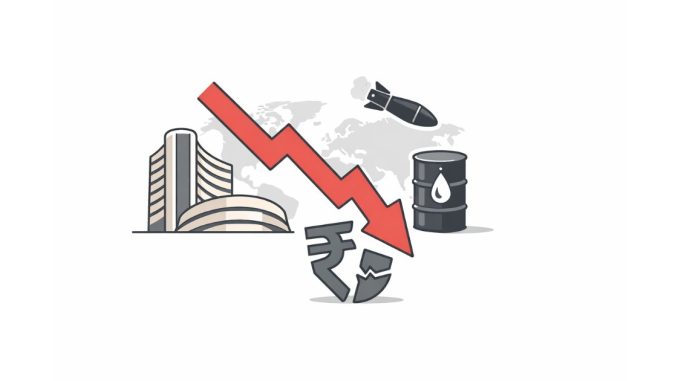
Stock market crash in India wipes out ₹8 lakh crore as Sensex plunges over 1,500 points and Nifty falls below key levels amid US–Iran tensions and rising crude oil prices.
India’s equity markets witnessed a sharp sell-off on Friday, with benchmark indices crashing significantly and investor sentiment turning cautious. The stock market crash in India saw the BSE Sensex fall over 1,500 points, while the NSE Nifty dropped below crucial psychological levels, reflecting widespread selling pressure across sectors.
The decline marked one of the steepest single-day falls in recent weeks, erasing nearly ₹8 lakh crore in market capitalisation and underscoring the vulnerability of domestic markets to global developments.
Sharp Fall Across Benchmark Indices
The BSE Sensex dropped more than 1,500 points during intraday trade, while the NSE Nifty slipped below key support levels, breaching investor confidence.
Market data showed that the Nifty fell below the 22,900–23,000 range, a level considered important by analysts for short-term stability.
The sell-off was broad-based, with almost all sectoral indices ending in the red. Banking, IT, auto, and energy stocks led the decline, reflecting widespread market weakness.
Mid-cap and small-cap stocks also witnessed heavy selling, indicating that the correction was not limited to large-cap stocks but affected the broader market.
₹8 Lakh Crore Investor Wealth Wiped Out
One of the most significant impacts of the crash was the erosion of investor wealth. Market capitalisation of listed companies on the BSE declined sharply, wiping out approximately ₹8 lakh crore in a single session.
This reversal came after a brief period of recovery earlier in the week, highlighting the volatile nature of current market conditions.
Such large-scale wealth erosion not only impacts institutional investors but also retail participants, many of whom have increasingly entered equity markets in recent years.
Key Triggers Behind the Market Crash
1. Escalating US–Iran Tensions
The primary trigger for the stock market crash in India has been rising geopolitical tensions involving the United States and Iran.
The ongoing conflict has created uncertainty in global financial markets, prompting investors to move away from riskier assets like equities.
Geopolitical instability often leads to heightened volatility, as investors seek safer investment avenues such as gold and government bonds.
2. Surge in Crude Oil Prices
Rising crude oil prices have added to market concerns. Oil prices have surged significantly due to fears of supply disruptions linked to the conflict.
For India, which imports a large portion of its crude oil requirements, higher oil prices can have multiple economic implications:
- Increased inflation
- Higher import bills
- Pressure on corporate margins
Analysts warn that sustained high oil prices could significantly impact India’s economic outlook.
3. Weak Global Market Sentiment
Indian markets mirrored weakness in global equities, as investors across the world reacted to geopolitical risks and economic uncertainties.
Global indices have shown volatility, and emerging markets like India tend to be more sensitive to such shifts in sentiment.
4. Foreign Investor Outflows
Foreign Institutional Investors (FIIs) have continued to pull money out of Indian markets, adding to selling pressure.
Large-scale outflows have been driven by:
- Rising US bond yields
- Strengthening US dollar
- Increased risk aversion
This trend has further weakened market sentiment and contributed to the decline.
5. Rupee Depreciation
The Indian rupee has also come under pressure, hitting record lows against the US dollar.
A weaker rupee increases import costs and raises concerns about inflation, which in turn affects equity markets negatively.
Sector-Wise Impact
The stock market crash in India affected multiple sectors:
- Banking and Financials: Faced heavy selling due to concerns over economic slowdown
- Oil and Gas: Impacted by rising crude prices
- Auto and Aviation: Sensitive to fuel costs, saw sharp declines
- IT Stocks: Weakened due to global uncertainty
Only a handful of defensive sectors showed resilience, but overall market breadth remained negative.
Understanding Why Markets React Sharply
Stock markets are highly sensitive to global developments. Events such as wars, geopolitical tensions, and commodity price shocks can trigger rapid changes in investor behaviour.
When uncertainty rises, investors tend to:
- Sell equities
- Move to safer assets
- Reduce exposure to emerging markets
This “risk-off” sentiment was clearly visible during the latest crash.
Impact on Retail Investors
The sharp fall has raised concerns among retail investors, many of whom have entered the stock market in recent years.
For small investors, such volatility can be unsettling. However, market experts often advise against panic selling during short-term corrections.
Instead, long-term investors are encouraged to:
- Focus on fundamentals
- Avoid emotional decisions
- Maintain diversified portfolios
Broader Economic Implications
The stock market crash in India is not just a financial event—it reflects broader economic concerns.
Rising oil prices and geopolitical tensions can:
- Increase inflation
- Slow economic growth
- Affect government finances
If global uncertainties persist, they could impact India’s macroeconomic stability in the coming months.
Comparison with Previous Market Corrections
The current crash follows a pattern seen earlier in March, when markets reacted sharply to similar global triggers.
Previous sessions also witnessed:
- Sharp declines in indices
- High volatility
- Significant wealth erosion
This indicates that markets remain highly sensitive to external factors.
What Experts Are Saying
Market analysts suggest that the current correction is largely driven by external factors rather than domestic weaknesses.
They point out that:
- Corporate earnings remain stable
- Domestic economic indicators are relatively strong
- The sell-off is primarily sentiment-driven
However, they caution that prolonged global uncertainty could lead to further volatility.
What Lies Ahead for Dalal Street
The near-term outlook for Indian markets will depend on several key factors:
- Developments in US–Iran tensions
- Movement in crude oil prices
- Global market trends
- FII investment patterns
If geopolitical tensions ease, markets could stabilise. However, continued uncertainty may keep volatility elevated.
Conclusion: A Volatile Phase for Markets
The latest stock market crash in India highlights the interconnected nature of global and domestic markets.
While the fall has been sharp, it is largely driven by external factors such as geopolitical tensions and rising oil prices.
For investors, the current phase serves as a reminder of the importance of staying informed, maintaining discipline, and focusing on long-term investment strategies.
Last Updated on: Friday, March 27, 2026 3:42 pm by BUSINESS SAGA TEAM | Published by: BUSINESS SAGA TEAM on Friday, March 27, 2026 3:42 pm | News Categories: Business News Today, Business Saga News
About The Author


Leave a Reply