
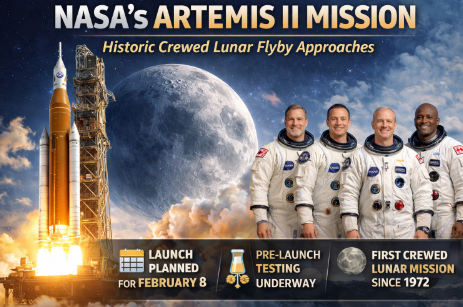
Cape Canaveral, FL — NASA’s Artemis program — the long-anticipated U.S. space initiative to return humans to lunar space — is entering a decisive phase as engineers and mission teams prepare for the first crewed flight of the Space Launch System (SLS) rocket and Orion spacecraft in more than half a century. The mission, Artemis II, is poised to carry four astronauts on a 10-day journey around the Moon and back, marking a defining moment in human space exploration.
Wet Dress Rehearsal Underway — Critical Test for Launch Readiness
NASA engineers have begun a full “wet dress rehearsal” — a comprehensive pre-launch test that simulates nearly all aspects of launch day, including fueling of the massive SLS rocket and countdown procedures at Kennedy Space Center in Florida. This rehearsal is a key milestone that allows teams to verify critical systems and processes ahead of committing to an official launch date.
Despite facing challenging weather conditions, including strong winds and cold temperatures that briefly hindered operations, teams continue to push forward with the rehearsal and readiness timeline.
Fueling Challenges Highlight Mission Complexity
In one of the latest developments, NASA reported fuel leaks during a practice countdown of the Artemis II rocket — echoing similar technical issues from past SLS preparations. Engineers and mission controllers worked through the day to manage excess hydrogen buildup and other complexities associated with handling the cryogenic propellants required for the mission.
Such technical hurdles are not unusual with cutting-edge, heavy-lift rocket systems but highlight the precision and safety focus needed before NASA commits to placing humans aboard.
Launch Timeline: February 8 and Beyond
Initially scheduled to launch the Artemis II mission in early February, weather-related delays — including rare Arctic blasts in Florida that threatened hardware and fuel systems — have shifted NASA’s target window. The earliest feasible launch is now aimed for Feb. 8, 2026, with final confirmation pending the outcome of the wet dress rehearsal and favorable weather forecasts.
This crewed flyby will be the first time humans have ventured beyond low-Earth orbit since NASA’s Apollo 17 mission in 1972.
Historic Significance and Mission Goals
Artemis II builds on the success of the uncrewed Artemis I test flight, which demonstrated the full integration of the SLS rocket and Orion spacecraft systems. Its primary objective is to validate critical crew safety systems, spacecraft performance, and navigation capabilities in the deep-space environment.
The mission will carry four astronauts — including experienced NASA spacefarers and an international partner crew member — to lunar distance on a free-return trajectory. This means the spacecraft will loop around the Moon and safely return to Earth without entering lunar orbit, ensuring crew safety and mission robustness.
Why Artemis Matters Now
Artemis II is a vital building block toward NASA’s broader lunar ambitions, which include:
- Artemis III, the first mission planned to land astronauts on the Moon’s surface, including the lunar South Pole region.
- Establishing sustainable human presence on and around the Moon as a stepping stone for future Mars exploration.
In addition to scientific discovery, these missions are expected to strengthen international cooperation and inspire a new generation of engineers, scientists, and space enthusiasts worldwide.
Looking Ahead
If the current rehearsal progresses successfully and weather conditions improve, NASA could confirm a final launch date within the next few days. Engineers and astronauts remain cautiously optimistic about achieving this historic crewed mission, which signifies not just a return to lunar space but a renewed era of human exploration beyond Earth.
Quick Facts: Artemis II Mission
- Mission Type: First crewed lunar flyby under the Artemis program.
- Launch Vehicle: SLS rocket with Orion spacecraft.
- Crew Size: Four astronauts.
- Launch Window: Targeted no earlier than Feb. 8, 2026 (weather permitting).
- Mission Duration: Approximately 10 days.
- Significance: First human mission beyond low-Earth orbit since 1972.
Last Updated on: Tuesday, February 3, 2026 11:48 am by BUSINESS SAGA TEAM | Published by: BUSINESS SAGA TEAM on Tuesday, February 3, 2026 11:48 am | News Categories: Business Saga News, Trending News
About The Author


Leave a Reply