
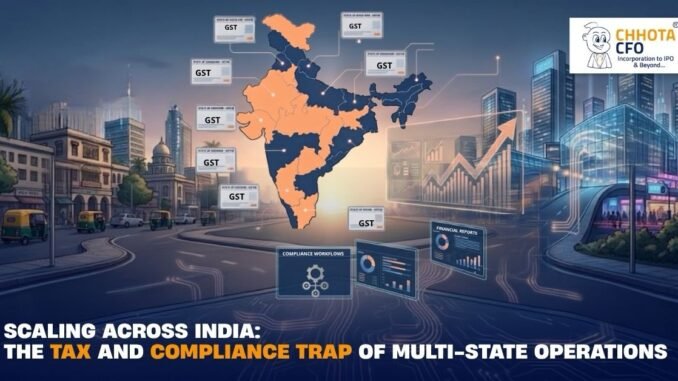
Expanding to a new city feels like growth. What most founders don’t see until it’s too late is that it also means entering a new compliance jurisdiction with its own GST registrations, professional tax obligations, and labour law thresholds. Here’s what the rulebook actually looks like.
One New State. Multiple New Obligations.
Opening an office, warehouse or operational establishment in Pune or deploying a sales team in Hyderabad triggers something most founders don’t budget for: a new compliance jurisdiction. The moment you make taxable supplies from a new state, your GST footprint, employment obligations, and TDS architecture all multiply automatically, and without notice.
India’s tax system is state-fragmented by design. A startup with presence in Maharashtra, Karnataka, and Telangana is treated as distinct persons for tax purposes, each having separate returns, input tax credit accounting and compliance obligations. It’s three separate registered entities under GST, each with its own returns calendar, ITC ledger, and audit exposure. Most companies discover this mid-audit, not in advance.
| Under the GST framework, registration is generally required in every State or Union Territory from which a person makes taxable supplies through a place of business or fixed establishment. Each GST registration (GSTIN) is treated as a distinct person for GST purposes, with separate compliance obligations. Each GSTIN is independent. |
The Three Compliance Traps
GST is the most visible obligation. Each state GSTIN requires separate monthly filings (GSTR-1, GSTR-3B), annual returns, and its own ITC reconciliation. ITC can only be claimed in the state where it was incurred meaning credits pile up in one location while cash goes out in another. This ITC leakage is common, costly, and entirely avoidable with the right structure.
Professional Tax is the obligation companies forget. Professional Tax is imposed by the State. Professional Tax laws differ from state to state. Depending on the jurisdiction, employers may have separate registration and enrolment obligations in addition to deducting and depositing Professional Tax from employees where applicable. Failure to enrol attracts arrears for all prior periods. In Maharashtra, persistent non-compliance can trigger prosecution.
TDS is where coordination breaks down. In multi-state operations, payments flow from multiple accounts managed by different teams. Without centralised tracking, deductions under 194C (contractors), 194J (professionals), and 194I (rent) are missed. Failure to deduct or deposit TDS may result in disallowance of 30% of specified expenditure under Section 40(a)(ia), apart from interest and penalties. Late deposits attract 1.5% interest per month.
What Gets Triggered and what’s at stake
| Compliance Area | Triggered By | Risk if Missed |
| GST Registration | Supply of goods/services in a new state | Penalty + demand notices + interest |
| Professional Tax | Employees working in a PT-applicable state | Arrears, fines, prosecution in some states |
| TDS Deduction & Filing | Payments to vendors, contractors, employees | Disallowance of expense + 1.5% pm interest |
| Shops & Establishments Registration | Opening an office in a new state | Closure orders, fines, operational disruption |
| Labour Law Compliance | Crossing headcount thresholds (10, 20, 100) Crossing employee thresholds prescribed under applicable labour laws (such as PF, ESIC, POSH and others) | PF/ESIC Regulatory penalties, interest, inspections and prosecution (where applicable), audit exposure |
Why a Virtual CFO Changes the Equation
The compliance cost of entering three new states: registrations, professional fees, team bandwidth and routinely runs into lakhs before a single revenue rupee flows. It never appears in the city P&L. It should.
A Virtual CFO builds the financial architecture before expansion, not after. That means GST registration sequencing, centralised TDS tracking, PT mapping by state, ITC reconciliation processes, and a single compliance calendar across every location at a fraction of the cost of a full-time hire.
Companies that get this right don’t just avoid penalties. They move faster, because they’re not stopping to fix what should have been structured from day one.
Geographic expansion is a compliance event, not just a commercial one. At Chhota CFO, we work with growth-stage startups and MSMEs to build this infrastructure before they need it, so compliance becomes a competitive advantage, not a catch-up game. If you’re planning to expand across states and want to get the architecture right the first time, we should talk.
Last Updated on: Thursday, July 30, 2026 11:52 am by Prachi Chadha | Published by: Prachi Chadha on Thursday, July 30, 2026 11:52 am | News Categories: Brand Post
About The Author


Leave a Reply